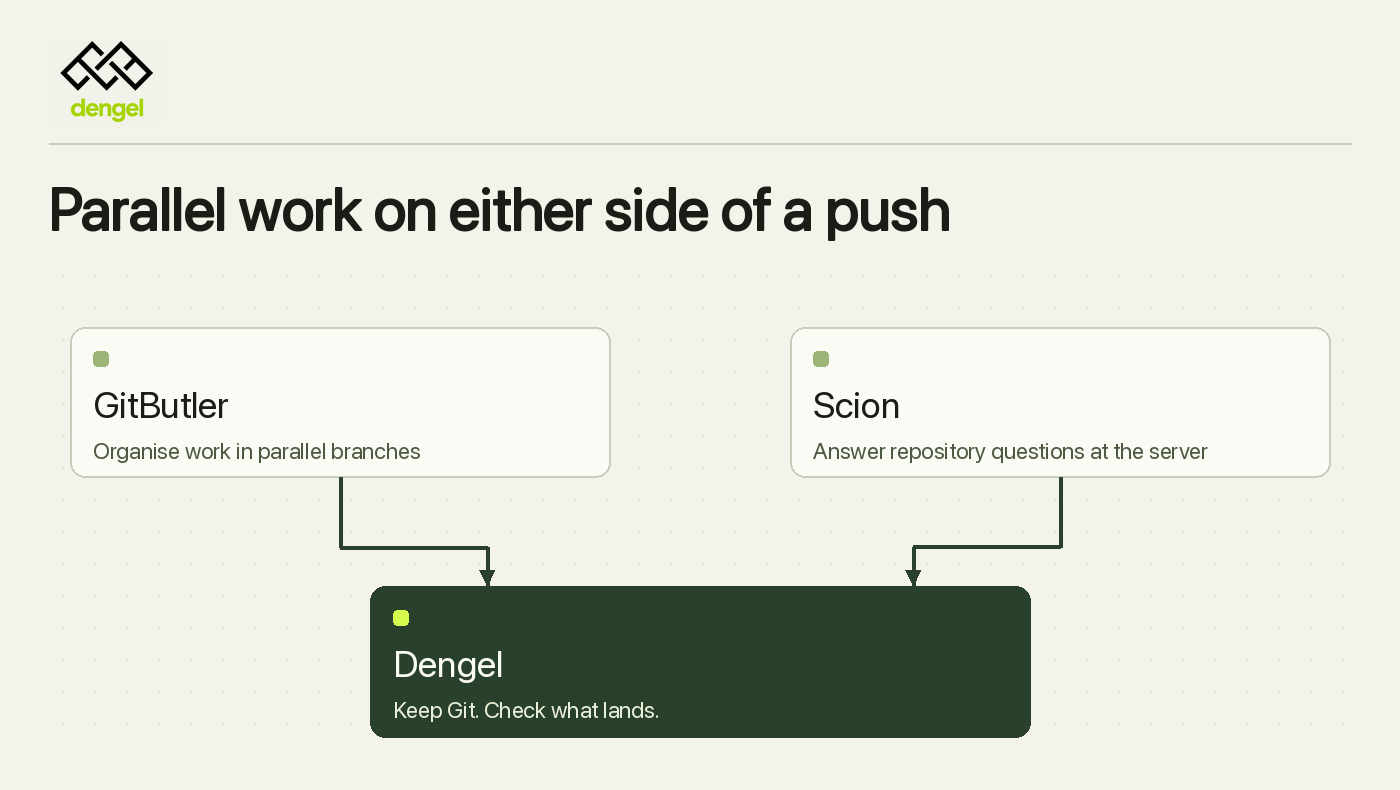
GitButler made us look at how work is organised before a push. Anthropic’s Scion write-up made us look harder at what the server can do after it. Both influenced Dengel. The interesting bit is what happens when you take those ideas back to a Git repository a small team actually uses.
GitButler and work in progress
GitButler lets you work on several branches in one working directory and commit to them independently. That’s handy when two changes are in flight and you want to keep their histories separate. You can see what belongs to each branch and decide whether one piece of work really depends on the other. GitButler’s parallel branches documentation
The lesson for us was that parallel work needs a place to live before anyone decides how it fits together. Imagine one agent fixing a checkout retry and another changing its timeout. Keep the two changes separate while they’re being worked on. When they reach the remote, make it easy to see which candidate you’re reviewing and whether it depends on the other one.
Scion and the work a server can do
Anthropic later published how it moved its own monorepo to Scion. In that setup, the server answers questions about history and diffs and performs operations such as merges and rebases. A job that only needs to know what changed can ask the server, with no full checkout to maintain. Anthropic was solving for the scale and shape of its own work. Anthropic’s Scion engineering write-up
That sharpened a question we were already asking. When a reviewer or a short-lived job needs a diff, where should that work happen? A Git host can answer repository questions itself while regular Git clients still clone, fetch and push over the standard protocol. The two things can coexist. That’s a much more useful idea for Dengel than asking every small team to change version control.
Where Dengel Guard fits
We use ordinary Git for the handoff to the remote. Once the team turns the pushed commit into a proposal, Dengel Guard takes over the review and landing part. It brings the diff, checks and independent verification together for the exact candidate and target under review. Someone with merge rights still decides whether it lands.
Say one agent’s checkout retry has passed its checks, then the other agent’s timeout change lands first. The old result describes the previous base. Guard gives the reviewer a place to see which change was checked and why the proposed integration needs fresh evidence. Once an authorised reviewer approves and lands the verified change, the signed receipt records which commit actually made it in.
The next time two agents finish in the same repository, look at what you do before and after the push. How do you keep their changes separate, and how do you decide what can land together? Those are two different jobs. It helps when your tools know which one they’re doing.