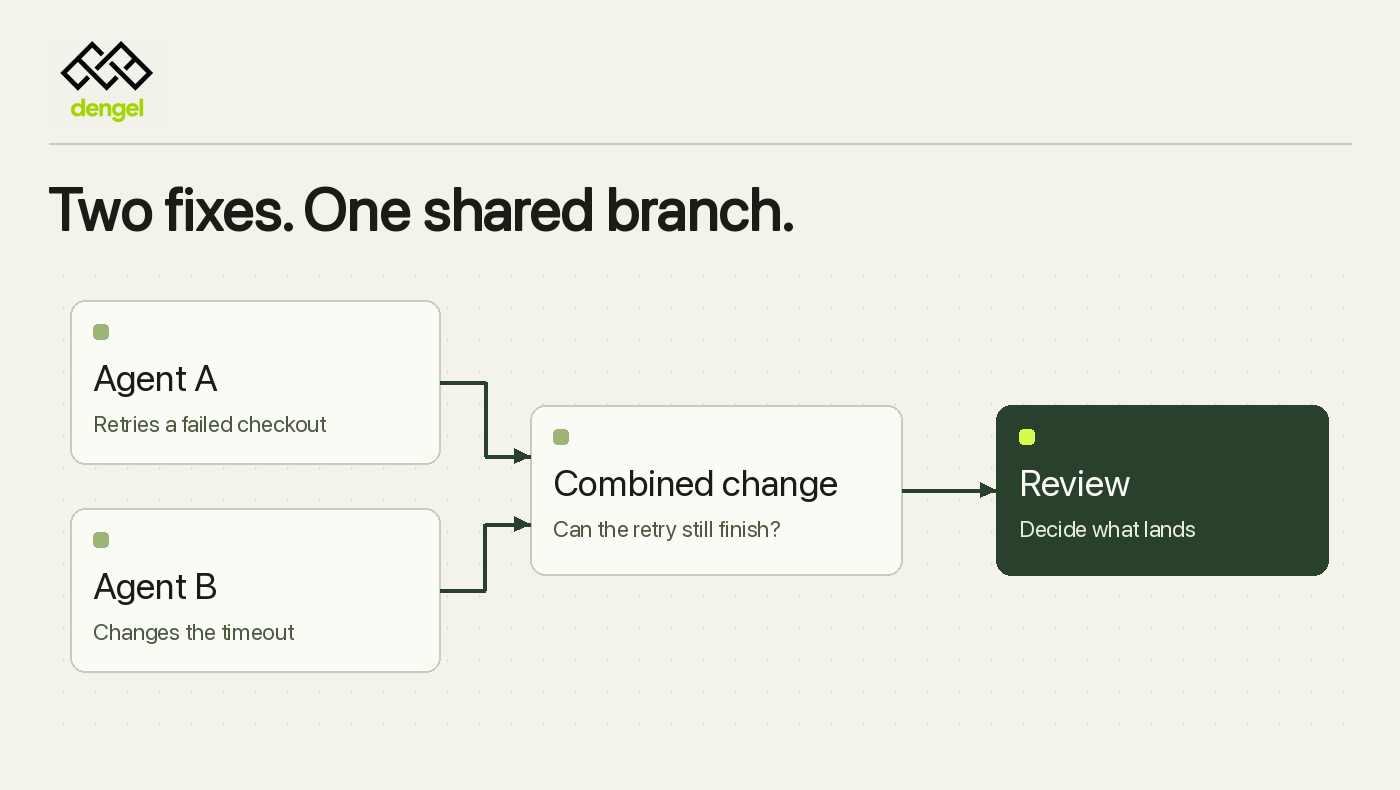
Two coding agents are working on the same repository. One adds retries to a checkout job. The other changes the timeout. Both patches pass their tests. Put them together and the timeout can interrupt the retry halfway through. Well, now somebody has to work out what actually ships.
That’s why we started Dengel. Getting more code written is getting easier. Getting several changes to work together still takes time. And when the same people have to review every patch, adding another agent can be a remarkably efficient way to make their queue longer.
We started with an observation
At NMA we started with a fairly boring plan, which was the point. Watch what happens when agents work on the same repositories. Count the collisions, see how often a patch needs a new base, and find out which problems can be sorted out mechanically. GitHub would stay the source of truth while we watched.
That constraint forced us to be specific. A merge conflict in one file is easy to see. Two patches in different files can change the same behavior and merge without complaint. And some apparent conflicts simply disappear when a proposal is checked against the newer target. Those are different problems. A useful system has to show the difference before it can help anyone decide what to ship.
The decision belongs with the team
We built Dengel around plain Git and a separation of responsibilities. An agent can produce a candidate. A separate verifier can check that candidate. A person with the right permissions decides what reaches the protected branch. If the candidate changes, its previous checks describe an older version. If the target branch changes, the proposed integration may need fresh evidence.
We also wanted teams to be able to choose where their repositories live and keep working with the agents they already use. NMA builds Dengel in Hamburg, and EU repository hosting is part of the product. Hosting, execution and inference are separate decisions, which matters when a team needs to know where each part of the work happens.
There’s an economic question in this, too. A team can replace a long review thread with a second expensive model run and still have a long review thread when the result is unclear. The original strategy discussion raised exactly that problem. A cheap deterministic check can settle some questions. Save deeper independent review for changes that warrant it, and count the cost per change the team actually accepts.
Try this the next time two agents finish work on the same repository. Ask which combined version was tested and who can approve it. If answering takes three tabs and a trip through the chat history, that’s the work we’re trying to take off your plate.